JetPallet Try it free

Use case · Cost and CO₂e

Cost per unit and CO₂e: compare options with your own figures

What does a product cost in packaging and freight – and how does that change when more cartons fit on the pallet? JetPallet calculates the cost per carton and per unit from your own assumptions and the pallet as actually packed. You compare patterns, carton options and vehicles side by side. CO₂e comes in as a scenario using factors you enter yourself and back up with a source.

Pattern comparison with scoring

1200 mm800 mm350 mm350 mm250 mm250 mm350 mm350 mm
Layer plan: carton 350 × 250 mm on 1200 × 800 mm – 10 per layer. Drawn by this page’s web calculator.

Workflow

How it works in JetPallet.

  1. 1

    Enter your cost assumptions

    Under “Calculate costs”, enter freight per pallet, pallet cost, cost per carton, units per carton and goods value per unit – plus tier sheets and film price per kg if you use them.

  2. 2

    Compare patterns and options

    “Compare variants” lists the pallet patterns found with carton count, unit count, cost per pallet and per unit. In the scenario lab you save up to four complete planning states, each with its own dimensions and costs.

  3. 3

    Choose the vehicle by cost

    With a cost per trip and per kilometre, the cheapest-vehicle search looks for a low-cost feasible combination of built-in and custom cargo spaces and shows it next to the “fewest vehicles” option. The search is exact only for small cases; otherwise the result is labelled as an approximation.

  4. 4

    Set up and document a CO₂e scenario

    Enter factors for transport (kg CO₂e per tonne-kilometre) and materials (kg CO₂e per kg) together with their source. JetPallet works out the covered total and the figure per unit, and exports everything as CSV or JSON.

Freight is paid per pallet, products are sold per unit

Carriers usually charge per pallet or per vehicle, yet carton size and pattern are often chosen on the price of the carton. A slightly dearer carton that lets more fit on a pallet can work out cheaper per unit – but you only see that when carton count, pallet count and costs are calculated together.

CO₂e is similar: without a link to the actual load, a figure per shipment stays abstract. And once options live in several spreadsheets, it is hard to tell which assumptions sit behind which number.

What you end up with

  • Cost per pallet, per carton and per unit
  • Pattern comparison PDF with an optional scoring page
  • Scenario report PDF
  • Cheapest vehicle combination compared with “fewest vehicles”
  • CO₂e per option and per unit
  • CO₂e data as CSV and JSON with factors and sources

In detail

In detail

01

Cost per carton and per unit

Packaging cost is the pallet cost plus carton count × cost per carton, plus tier sheets and stretch film if you enter them. Add freight and you get the total cost per pallet, per carton and per unit. Everything is based on the currently selected solution – change the pattern and the unit costs follow.
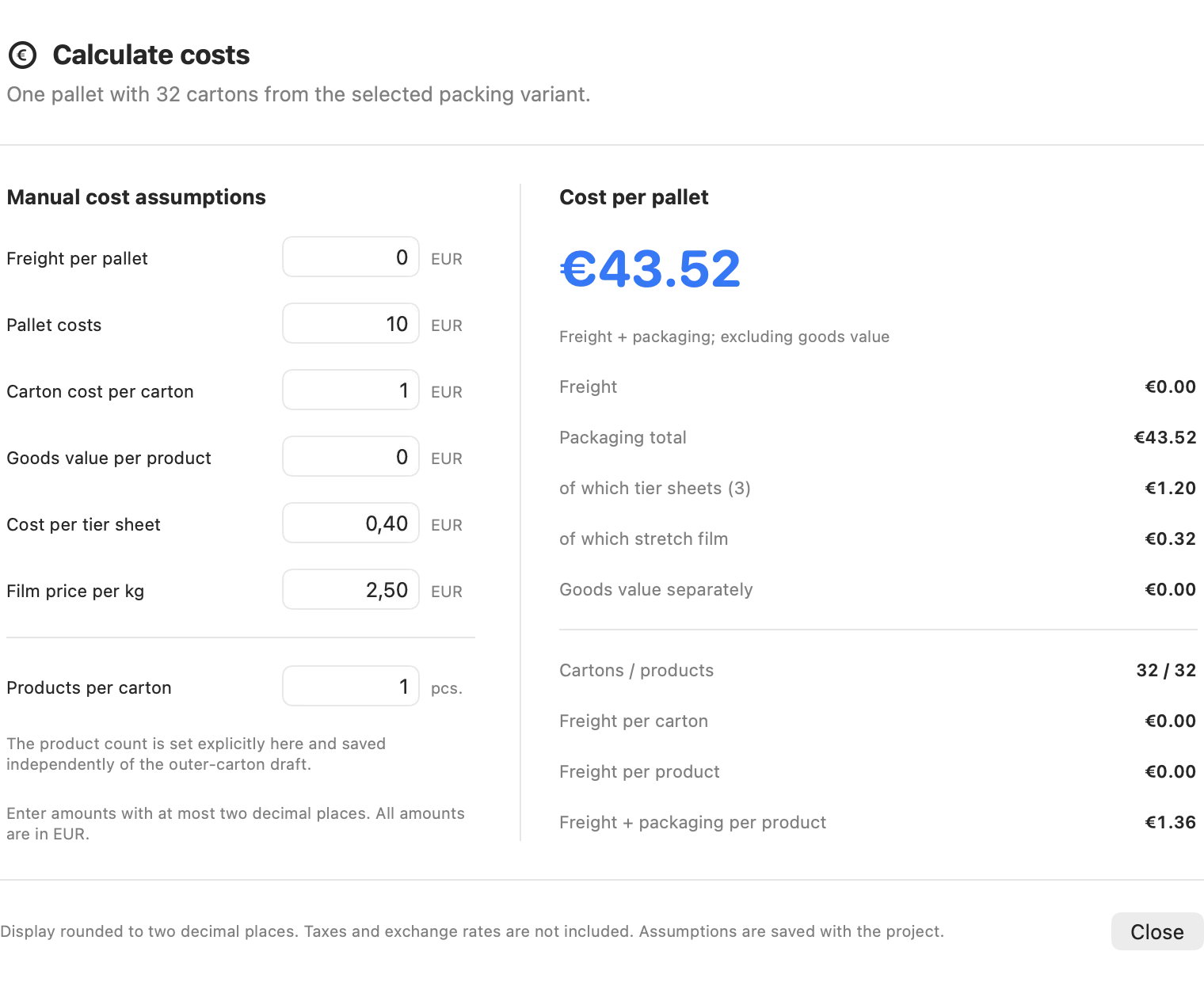
Cost per carton and per unit
Actual JetPallet interface.

02

Scenario lab for complete planning states

A scenario stores carton dimensions, weights, pallet, limits, pattern preference and cost assumptions. That lets you set today’s carton against a proposal from the shipping carton calculator. The scenario report PDF shows the results and the inputs behind each one.

03

Cheapest vehicle with a CO₂e comparison figure

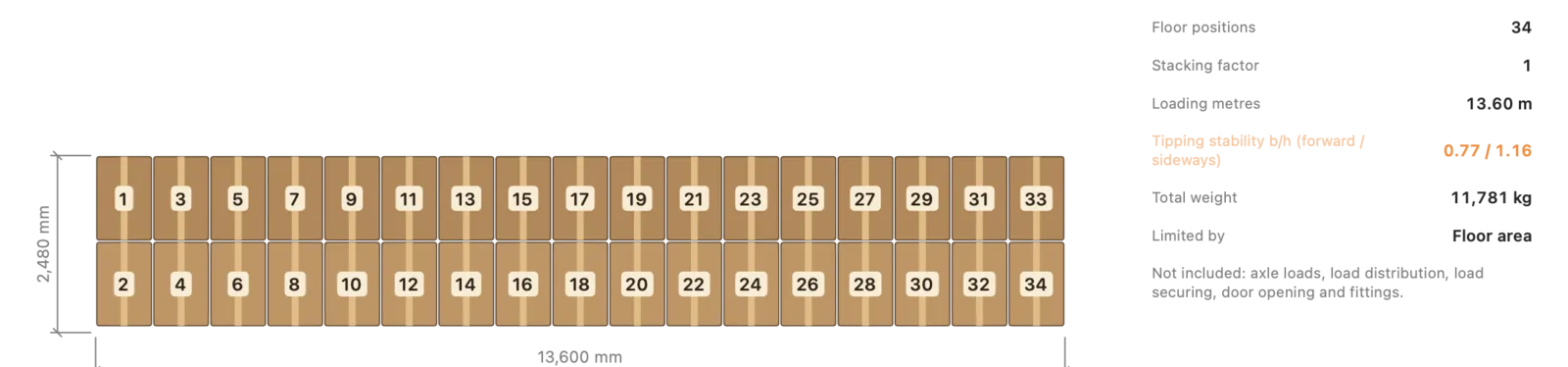
For each cargo space you store a cost per trip, a cost per kilometre and, optionally, your own factor in kg CO₂e per vehicle-kilometre. Given the distance, each option shows its cost and vehicle-kilometres × factor; once two options are rated, the one with the lowest CO₂e is flagged. The cost ranking stays as it is. More under Truck and container loading.

Cheapest vehicle with a CO₂e comparison figure
Actual JetPallet interface.

04

CO₂e scenarios with traceable factors

A CO₂e scenario combines transport and material shares with factors, sources, versions and validity dates. CSV and JSON are recalculated on export and contain raw data, individual values and factors, so anyone can trace where a figure comes from. Invalid scenarios cannot be exported.

Questions

Frequently asked questions.

How do I calculate freight cost per unit?

Divide the freight per pallet by the number of units on the pallet, that is cartons per pallet × units per carton. The more cartons fit, the lower the share per unit. JetPallet does this from the pallet as actually packed.

Where do the CO₂e factors come from?

From you. JetPallet ships no emission factors; it stores the factors you enter together with source, version and validity and includes them in the export.

Is this an ISO 14083 carbon footprint?

No. The CO₂e values are comparison and scenario figures based on your factors. An ISO 14083 or GLEC footprint needs its own complete calculation.

Run the options with your own numbers

Try JetPallet free for 14 days with every feature, then USD 99 a year. Requires macOS 15 or later.

Try it free

Free for 14 days · then USD 99/year

Try it free14 days freeUSD 99/year