JetPallet Try it free

Use case · Load securing

Estimate load securing – for each pallet row and after every stop

How many straps a load needs for top-over lashing depends on mass, friction, lashing angle and pretension – and on whether the headboard may take part of the load. JetPallet estimates the number of top-over lashings following the EN 12195-1 calculation method for each pallet row, assesses the headboard with reference to EN 12642 and, on multi-drop routes, recalculates the remaining load after every stop. The result is a planning aid, not a clearance.

1200 mm800 mm1410 mm
Single-SKU pallet: 40 cartons in 5 layers with tier sheets, edge protection and strapping. Illustration, calculated with this page’s web calculator.

Workflow

How it works in JetPallet.

  1. 1

    Plan the vehicle

    Build the arrangement in mixed-item and multi-drop planning. Every pallet needs a known mass; pallets without one are not calculated and the total is marked as incomplete.

  2. 2

    Set the inputs

    Enter the strap’s standard tension force (STF) – 500 daN by default –, the lashing angle (60° by default), the materials in contact (friction factor μ) and the headboard type. With unknown friction JetPallet uses μ = 0.2; an anti-slip mat counts as 0.6.

  3. 3

    Read the result per row

    Pallets that overlap along the length form a row. For each row you see the straps per direction, whether it is blocked forwards, the total and every warning, such as gaps or missing support.

  4. 4

    Step through the stops

    For multi-drop plans the remaining load is reassessed after every stop – blocked or not, and how many straps – with a reminder to re-secure after each partial unload.

  5. 5

    Add it to the PDF

    If you choose, JetPallet appends dedicated “Load securing – estimate” pages to the vehicle load plan: disclaimer, inputs, formula, a table per row and notes.

Why the strap count matters at the planning stage

With top-over lashing the straps press the load onto the deck, and it is the extra friction that holds it under braking, cornering and acceleration. With slippery materials in contact and heavy pallets you can quickly need more straps than the truck carries. If the load stands flush against a headboard that can take the force, far fewer are needed in the forward direction.

Multi-drop routes add another twist: every partial unload leaves gaps, the blocking is lost and the remaining pallets need securing again. Seeing this in the load plan lets you arrange pallets differently or plan in aids such as anti-slip mats.

What you end up with

  • “Load securing (estimate based on EN 12195-1)” section in the vehicle dialog
  • Optional pages in the vehicle load plan PDF with disclaimer
  • Assessment of the remaining load after every stop
  • Tipping note per pallet in the vehicle PDF (estimate)
  • Securing materials register with external documents as a PDF

In detail

In detail

01

Top-over lashing per pallet row

Each direction uses the road transport coefficients: 0.8 forwards, 0.5 backwards and sideways, with safety factors of 1.25 forwards and 1.1 sideways and backwards. The straps of a row run across every pallet in it; the least favourable direction governs.
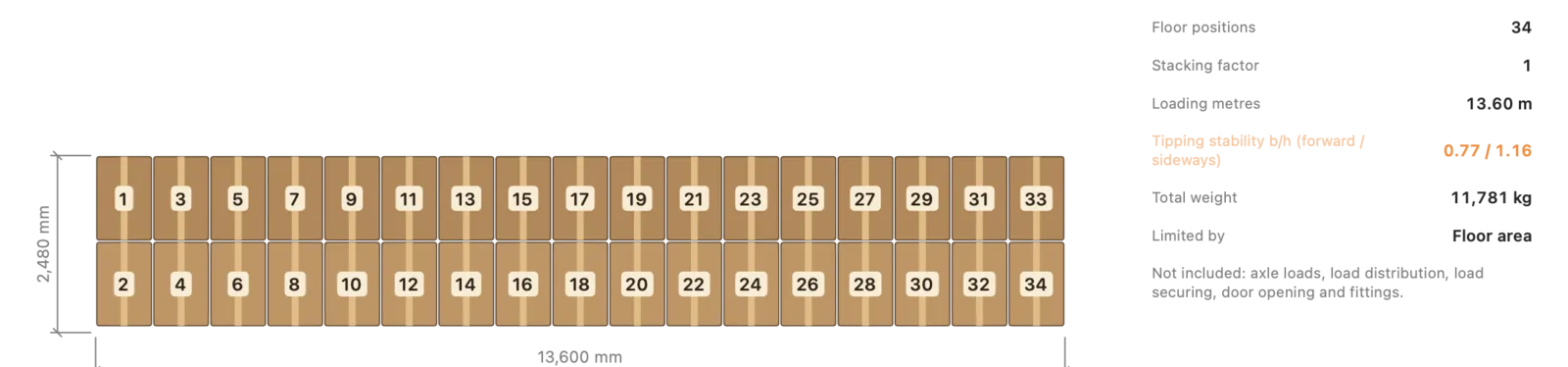
Top-over lashing per pallet row
Actual JetPallet interface.

02

Blocking only with an unbroken chain

A pallet counts as supported forwards if it stands against the headboard or sits flush against a pallet that is already supported, overlapping it by at least 100 mm across the width. If a link in the chain is missing, the whole row is lashed forwards as well. Sideways and backwards are always calculated, since nothing is assumed about side walls or doors.

03

Headboard per EN 12642

By default the headboard is treated as unable to take load. Choose code L and 40% of the payload is allowed, up to 5,000 daN; code XL allows 50%. You can also enter your own figure, from the body certificate for example. The payload comes from the cargo space profile, not from your planning limit. If the headboard is overloaded, JetPallet conservatively lashes the affected rows forwards with their full mass.

04

Worked example with assumptions

Two rows of 1,000 kg and 500 kg against a headboard of unknown type, friction unknown (μ = 0.2), 500 daN STF, 60° lashing angle: the forward direction governs, giving 5 and 3 straps, 8 in total. With an anti-slip mat or a rated headboard the result changes – which is exactly what the estimate is for.

05

Further notes

There is also an estimate for direct lashing (slanted and diagonal lashing) and notes on side and rear walls per EN 12642; for flat-rack containers the side wall is treated as unknown. The tipping note per pallet, from its width-to-height ratio, is an estimate using coefficients from secondary sources – not a geometric stability check. In the “Securing materials” tool you list edge protectors, strapping, film or anti-slip mats and attach external documents.

06

Evidence package for securing documents

You bind external documents such as test reports or certificates to the securing materials register with a SHA-256 checksum. The evidence package bundles the project and solution state, the register, a freshly evaluated report and the documents; on import the whole package is checked and only applied after you confirm. The status “externally verified” applies only as per your assignment – JetPallet does not assess the content of the documents.

Questions

Frequently asked questions.

How many lashing straps does a pallet need?

It depends on mass, the materials in contact (friction), lashing angle, the strap’s pretension and whether the pallet is blocked against a headboard that can take the load. With unknown friction and no blocking it soon comes to several straps per row; an anti-slip mat reduces the number considerably.

Is JetPallet’s result binding under the standard?

JetPallet estimates using the EN 12195-1 calculation method. The values come from secondary sources and have not been checked against the standard’s text. The result is a planning aid and does not replace an inspection by a competent person.

Why is the headboard ignored by default?

Because without details nobody knows how much it may take. Only with code L, code XL or your own figure and a known payload does JetPallet credit the blocking.

Do I need to re-secure after a drop?

Usually yes, because a partial unload leaves gaps and the blocking is lost. JetPallet shows for every stop how blocking and strap count change.

See the strap count before the truck is loaded

Try JetPallet free for 14 days with every feature, then USD 99 a year. For macOS 15 or later, without a JetPallet account.

Try it free

Free for 14 days · then USD 99/year

Try it free14 days freeUSD 99/year